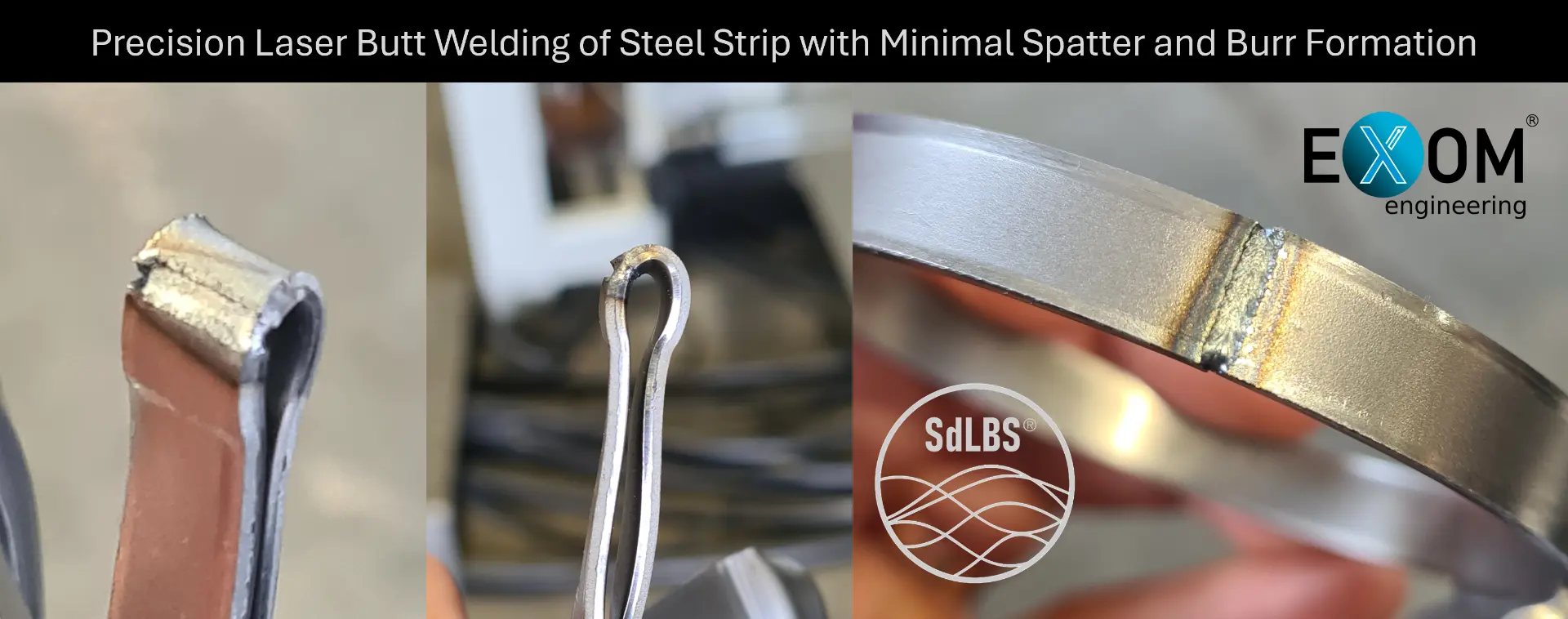
Laser butt welding of steel strip has become a key technology for industrial applications requiring high precision, repeatability, and superior weld quality. One of the main challenges in this type of process is minimizing spatter and deformation in the areas adjacent to the weld seam, especially in downstream forming or stamping operations where even minimal excess material can directly affect final part tolerances.
Achieving stable, low-spatter results requires the correct combination of wobble frequency and welding speed. The wobble movement allows a controlled distribution of laser energy across the joint, improving melt pool stability and reducing localized thermal peaks. However, defining the correct wobble path alone is not sufficient: the internal energy distribution within the wobble pattern itself plays a decisive role in the final weld quality.
A properly optimized energy modulation enables the production of weld seams with very low reinforcement and a transition zone with almost no burr formation between the welded area and the base material. This aspect is especially important in automated continuous production lines, where even small irregularities can create cumulative problems during subsequent manufacturing stages.
In this context, the integration of advanced optical systems with industrial vision cameras becomes essential. These solutions allow critical aspects to be identified already during the pre-series phase, including strip tolerance variations, geometrical deviations, edge alignment, and material-specific thermal behavior. Through real-time visual analysis, process parameters can be optimized before serial production begins, significantly reducing setup times and improving overall process stability.
Equally important is the synchronization between stamping, forming, and welding processes in order to achieve parts within specification. Weld quality should never be evaluated as an isolated parameter, but rather as an integral part of the complete manufacturing chain, where each process step directly influences the final result. Only through the proper coordination of tooling design, material preparation, and laser welding strategy can manufacturers achieve high-precision components with excellent mechanical properties and optimized surface quality for demanding industrial production environments.
Applications
Laser Welding 2026-02-06
Precision Laser Butt Welding of Steel Strip with Minimal Spatter and Burr Formation
Have a project in mind?
Tell us about your application and our engineers will find the right solution.