Laser welding in controlled atmosphere environments has become a key enabling technology for industries demanding the highest weld quality, repeatability, and process reliability. Applications in telecommunications, energy storage, medical devices, and advanced electronics increasingly require defect-free welds with minimal oxidation, low thermal distortion, and precise energy control. Integrating laser welding systems inside gloveboxes or sealed chambers allows manufacturers to process sensitive materials such as copper, aluminum, titanium, nickel alloys, and battery components under inert gas atmospheres, significantly improving final weld quality.
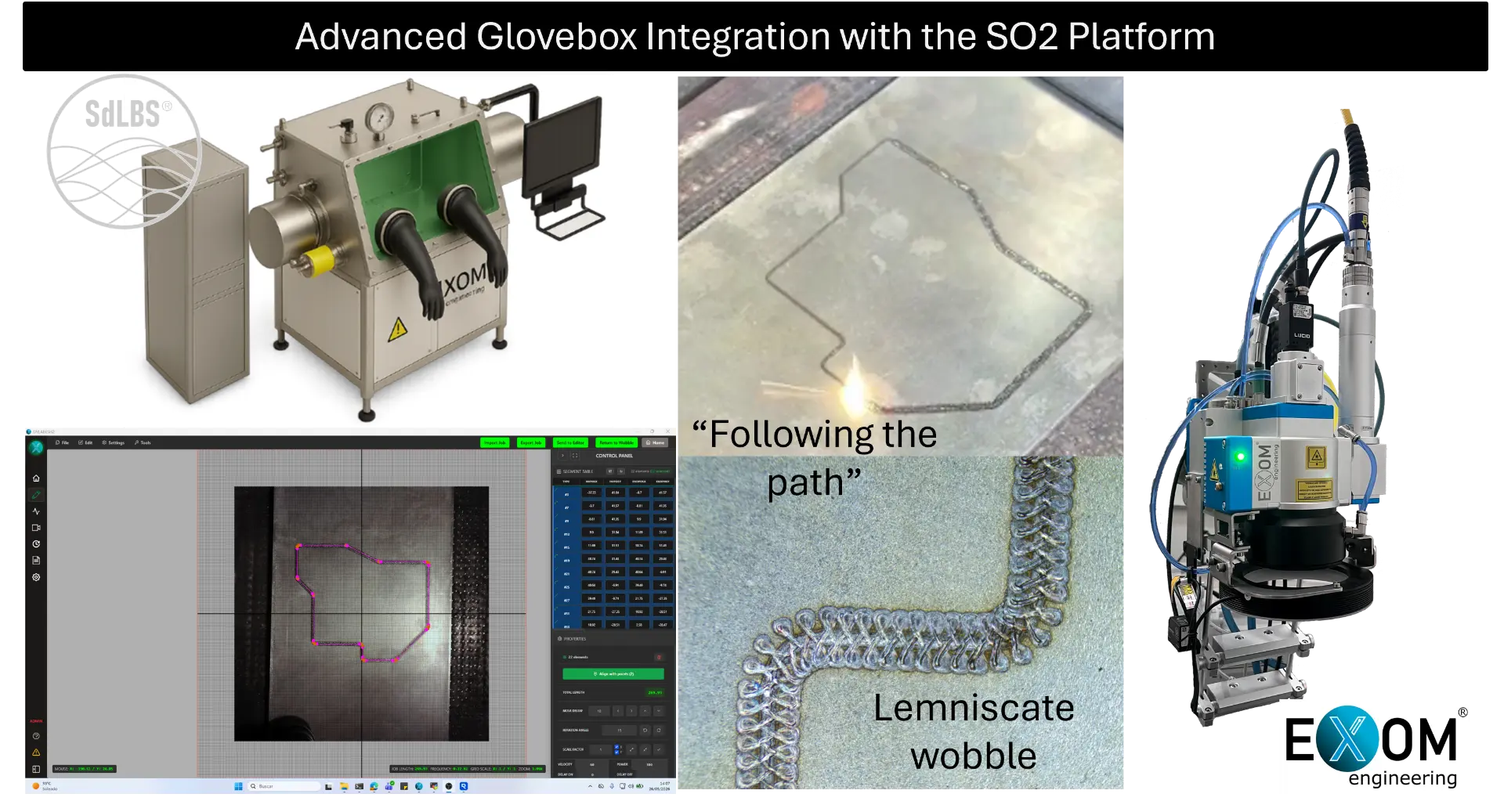
The combination of the Exom Engineering SO2 laser welding platform with the DYLABESH2 software environment provides a highly flexible and integrated solution for these demanding applications. Working in controlled atmospheres such as argon or nitrogen reduces contamination and oxidation during the welding process, which is especially critical for sectors like battery manufacturing, hermetic sealing, medical implants, and high-frequency telecommunication components.
One of the main advantages of the SO2 system is its advanced visualization capability. Through DYLABESH2, operators can simultaneously monitor two different camera views during the process. The first camera offers a larger overview of the welding area, helping users position components and supervise the overall operation. The second camera is coaxial to the laser beam, providing a highly detailed and precise view directly aligned with the welding spot. This dual-camera configuration greatly simplifies process setup, alignment, and quality control while improving operator confidence and reducing setup times.
Beyond visualization, the platform allows deep integration of additional mechanical actuators directly into the welding script function. Clamping systems, positioning devices, rotary axes, or custom tooling can be synchronized with the welding process itself. This enables perfectly coordinated operation between laser beam shaping, welding trajectories, beam positioning, and the clamping mechanism. Such synchronization is particularly important in applications where part stability, thermal management, or dynamic positioning are essential to achieving consistent weld quality.
Another important enhancement is the ability to import DXF files directly into DYLABESH2. This function simplifies data handling and significantly reduces programming effort for complex welding geometries. Users can rapidly generate welding paths from CAD drawings, accelerating production preparation and minimizing the risk of programming errors. The result is a more intuitive workflow that improves flexibility for both prototyping and industrial production environments.
By combining controlled atmosphere welding with advanced software integration and process synchronization, the SO2 platform offers manufacturers a powerful solution for next-generation precision laser welding applications.
Applications
Laser Welding 2026-06-01
Precision Laser Welding in Controlled Atmospheres: Advanced Glovebox Integration with the SO2 Platform
Have a project in mind?
Tell us about your application and our engineers will find the right solution.